
Lately, I’ve been thinking a lot about tattoos. Not the large-scale designs covering arms and backs, but smaller, more restrained ones—symbols that feel intentional rather than decorative. While scrolling through my phone, I started noticing how often lip tattoos appear: tiny lip prints, stylized mouths, subtle outlines. They’re easy to miss, yet strangely hard to forget.
At first glance, it’s tempting to dismiss them as a trend. But the more I paid attention, the clearer it became that lip tattoos tend to carry meaning that isn’t immediately announced. Different people choose them for very different reasons. What follows isn’t a definitive explanation—just a closer look at the layers that seem to show up again and again.
I. The Most Obvious Reading: Love and Passion.
Lips are inseparable from intimacy. Kissing, closeness, desire—these associations are almost automatic.
A bold red lip print often reads as passion at first sight. Some people treat it like a permanent love mark, a reminder of a relationship, or even a private symbol meant for one specific person. In that sense, the meaning is direct and unapologetic.
Still, not everyone stops there. If affection were the only motivation, the permanence of a tattoo would feel excessive. That’s usually where deeper interpretations begin to surface.
II. Lips Are Also About Speaking.
This layer is easier to miss.
Beyond intimacy, lips are tools of expression. They shape words, carry tone, reveal hesitation or confidence. In visual culture, mouths have long symbolized voice, truth, and restraint—not just attraction.
Because of this, lip tattoos are sometimes read as reminders:
- to speak honestly,
- to reclaim one’s voice,
- or to resist silence when silence feels imposed.
Some people choose this symbol during periods when self-expression feels fragile. It isn’t always about being louder—sometimes it’s about refusing to disappear.
Not everyone reads lip tattoos this way, of course. For some, the symbolism stops at aesthetics. That tension is part of what makes the image flexible rather than fixed.
III. A Familiar Symbol of Feminine Allure.
It’s hard to ignore that many lip tattoos are chosen by women.
Full lips, especially vividly colored ones, have long been framed as markers of femininity—confidence, sensuality, presence. The image recalls classic cinema and fashion imagery, where a single red mouth could dominate the entire frame.
For some wearers, the tattoo isn’t meant to attract attention from others at all. It functions more like an affirmation: femininity on one’s own terms, without apology or performance.
Across cultures—from the Ainu women of Japan, whose lip tattoos once marked maturity and spiritual protection, to modern wearers—the mouth has long held layered significance beyond beauty.
IV. When a Lip Print Becomes a Memorial.
This meaning tends to stay private.
Some lip tattoos are chosen to preserve memory rather than desire. A print linked to a partner who passed away. A shape associated with someone no longer present. In these cases, the tattoo operates less as a symbol and more as an emotional anchor.
It’s subtle. Easy to misread from the outside. But for the wearer, it holds weight that doesn’t need explanation.
V. Color and Form Change the Story.
The same motif can shift meaning entirely depending on how it’s rendered.
- Red lips often signal confidence or intensity.
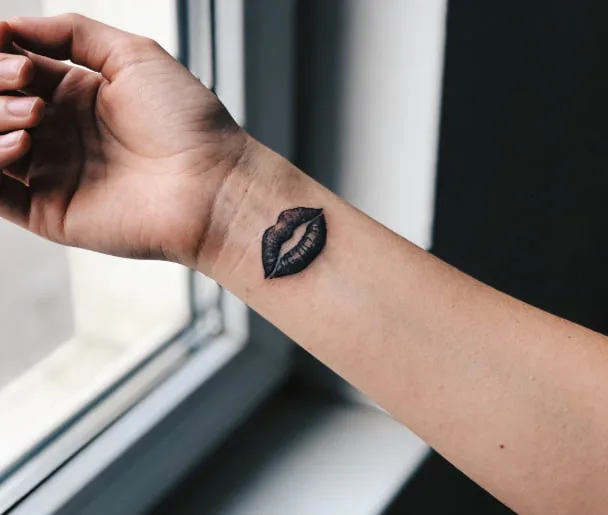
- Black or minimalist outlines lean toward restraint or emotional distance.
- Parted lips or biting gestures suggest longing, tension, or vulnerability.
- Paired elements—smoke, zippers, text—tend to push the image toward secrecy, control, or contradiction.
Tattoo artists often mention that these small design choices matter more than the motif itself. The lips may be the same, but the story rarely is.
VI. Placement Shapes Interpretation.
Placement quietly changes everything.
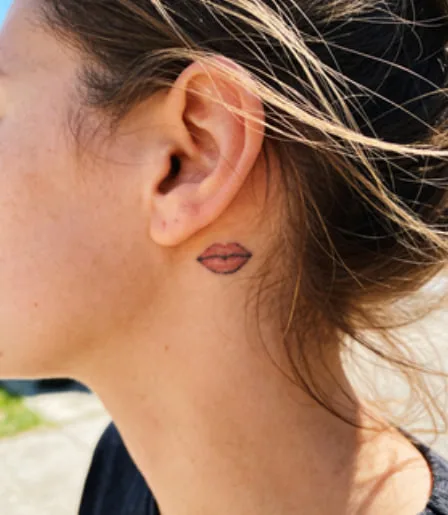
Some choose visible spots—hands, wrists, forearms—where the image becomes part of daily interaction. Others prefer hidden locations: behind the ear, along the ribcage, near the collarbone.
Several artists I’ve spoken with note that behind-the-ear placement is especially intentional. The symbolism feels balanced: lips represent speaking, while the ear represents listening. Seen only from certain angles, the tattoo becomes selective—visible to some, private to others.
In the end, a lip tattoo is rarely just an image. It’s a quiet choice about what to reveal, what to keep close, and how to carry meaning on skin that speaks only when it wants to.