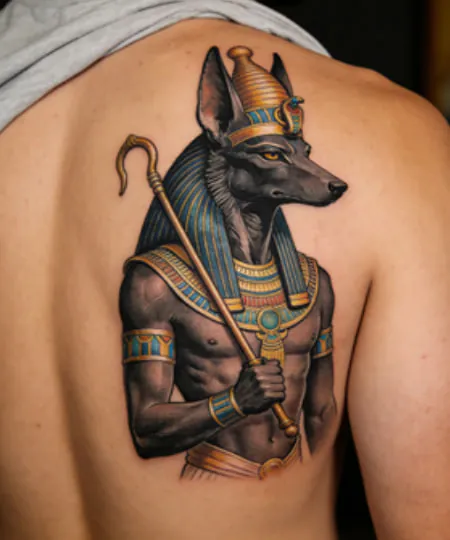
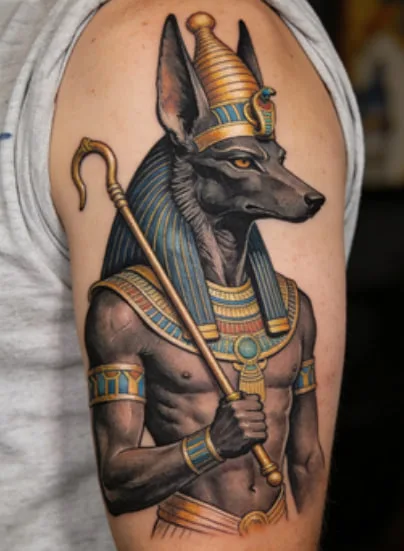
For many, the first word that pops into their minds upon seeing that jackal-headed deity is “death” or “mummies.” This reaction is perfectly natural, given how movies consistently portray him. But after spending time reading ancient texts and speaking with several old-school tattoo artists, I realized this is a common misunderstanding. This image isn’t meant to be frightening or morbid. Quite the opposite—it represents a guardian. When life throws you curveballs or chaos surrounds you, this guardian stands by your side to protect you.
Anubis is a uniquely special deity in ancient Egyptian mythology. His head resembles that of a jackal, while his body is human. In ancient tales, he was responsible for tending to mummies, governing the afterlife, and most importantly, serving as the guardian of souls. This is precisely why both men and women today choose to ink Anubis onto their skin. It’s not merely a cool design; it represents a profound spiritual anchor.
What Does an Anubis Tattoo Truly Represent?
Breaking down this symbol reveals several profound layers. Each meaning serves as a unique source of strength for those who choose it.
- Protection and Guidance: Anubis is often called the “Gatekeeper of the Underworld.” Ancient Egyptians believed he escorted souls safely on their journey from this world to the next. Tattooing this symbol is like hiring a personal spiritual bodyguard.
- Justice and Truth: Egyptian mythology features a famous scene. Anubis would place the deceased’s heart on one side of the scales, with the feather of truth on the other. If the heart outweighed the feather, it signified wrongdoing; if they balanced, the soul passed judgment. Thus, he also embodies the need for integrity and adherence to one’s moral compass.
- Transformation and Rebirth: As the overseer of the entire journey from birth to death, he symbolizes the cycle of life. This refers not only to physical death but more profoundly to major life transitions—ending old relationships, beginning new chapters, or adopting different ways of living. It embodies rebirth.
- Power and Control: His imposing presence represents formidable strength. It reminds the wearer to master their destiny rather than drift aimlessly.
Sometimes, the more you learn, the more you marvel at the profound wisdom of ancient people—truly awe-inspiring!
Where Should Men Get Tattoos?
Men often prefer larger areas when choosing tattoo placements. This allows for more intricate details, fully showcasing the power and complex lines characteristic of Egyptian art.
- Full Back: The back serves as a vast canvas. Here, you can design an epic scene—like Anubis standing at the center of scales flanked by pyramids. This layout excels in realistic styles, creating a truly imposing presence.
- Forearm or Sleeve: A popular choice. The arm’s elongated shape suits vertical compositions perfectly. You could feature just Anubis’ head, surrounded by hieroglyphs, scarabs, or the Eye of Horus. This creates a stylish, story-rich design.
- Chest: Placing Anubis directly above the heart holds special significance. It echoes the myth of the “Weighing of the Heart,” symbolizing your commitment to inner honesty. This powerful piece serves as a constant reminder to live with integrity.
Where Should Women Get It?
Women often favor elegance and symmetry in aesthetics. Their chosen placements typically accentuate the body’s curves while retaining mystical symbolism.
- Sternum or Below the Chest: This is a highly unique spot. Designs can feature symmetrical compositions, like a jackal head paired with spread wings (inspired by the goddess Isis). Such a design extending along the body’s midline can flatter the figure while appearing deeply sacred.
- Thigh: The thigh offers ample space to showcase intricate details. Opt for larger portraits with delicate lines or soft watercolor effects. It remains discreet under pants yet reveals itself when wearing shorts—perfectly versatile.
- Back of the Neck: For a more discreet option, the back of the neck is ideal. A simple, petite profile of Anubis’s face is delicate and charming. It serves as a silent guardian, always watching over your back.
Which Style Looks Best?
To make your tattoo stand out, consider experimenting with different artistic styles. Each style lends a distinct visual character to your Anubis tattoo.
- Realistic Black & Gray: This style emphasizes light, shadow, and texture. Artists use black and gray ink to render Anubis like an ancient stone sculpture—rich with historical depth and lifelike realism.
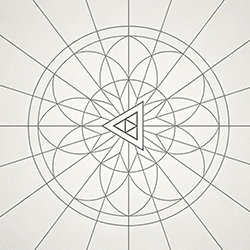
- Geometric or Mandala Style: Ancient Egyptians were masters of mathematics and geometry. Combining Anubis’s image with sacred geometric patterns, outlined with clean lines, is perfect for those who appreciate order and precision.
- Golden Accents: Against a black base, a touch of gold ink is added. Gold was the color of royalty and deities in ancient times. This subtle highlight instantly elevates the design’s sophistication, emphasizing the divine radiance.
My True Feelings.
People often ask me, “Did you get this tattoo because you’re into black magic?” Whenever I hear this question, I just smile it off. I share the true story. Anubis isn’t a god of chaos—he’s the one who stops it. He’s the ultimate guide. Ancient texts call him “the Pathfinder.”
Life can sometimes feel like a dark labyrinth, leaving us lost. But if you stay true to yourself, a way out always emerges. This symbol represents transition—moving from one stage of life to the next. Looking back at myself, that old job was incredibly stressful, leaving me emotionally drained and even heartbroken. Later, I decisively changed course and chose my current freelance life. Though the journey wasn’t easy, I found true happiness. This tattoo marks that pivotal shift in my life. It constantly reminds me that no matter how long the night, dawn will always come. As long as there’s light in your heart, you needn’t fear the distance ahead.