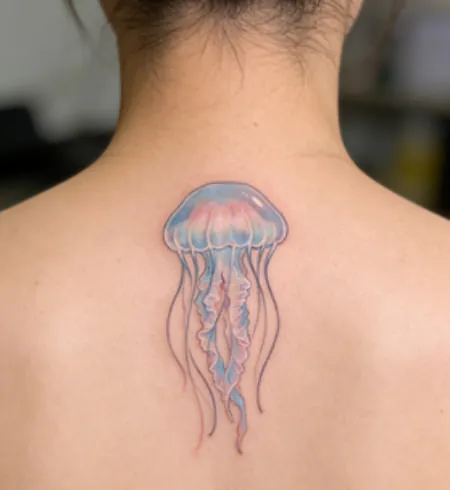
I’ve probably spent more time in tattoo shops than at home. Over the past decade, I’ve seen countless people walk in with all kinds of ideas, only to leave with designs permanently etched onto their bodies. In recent years, I’ve noticed a particularly fascinating trend: no matter where I go, I always see people discussing the meaning behind jellyfish tattoos. They appear on girls’ arms, guys’ ribs, even large sections of the back.
At first, I thought people just found them aesthetically pleasing. After all, those long tentacles drifting like silk are undeniably captivating. But when I sat down for deep conversations with several veteran tattoo artists, I realized it’s more than that. It’s not just about beauty; there are profound life stories hidden beneath.
Why Choose Soft, Floppy Jellyfish?
I spoke at length with Tom, a veteran artist who’s been wielding the needle since the nineties. He explained that when clients request a jellyfish, they’re seeking more than just a marine creature.
Tom noted that jellyfish have existed on Earth for 500 million years. Consider this: dinosaurs vanished, yet they endured. They don’t have bones, no real shell, not even a brain or a heart. Crazy, right? And yet they’ve been around forever. I guess that’s what gets me — they just survive by being… soft.
That’s basically why so many people are choosing jellyfish tattoos these days — it’s about being strong without having to look tough or unbreakable.
In this world, we often believe we must become strong and hard to protect ourselves. Like crabs with shells, sharks with sharp teeth. But jellyfish are different. They show us that softness can be a powerful weapon. You don’t need to wrap yourself up tightly or constantly bristle against the world. Sometimes just drifting with the current actually helps you last longer. A lot of the people I’ve talked to who’ve been through really rough stuff say this idea hits them hard.
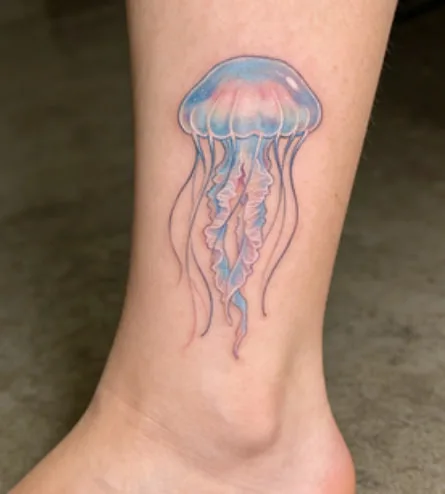
Learn to let go and go with the flow.
Modern life is exhausting. We strive to control everything, plan every step, grasp at all possibilities. When things go awry, anxiety and frustration follow.
Observe the jellyfish. They never fight the waves. Wherever the tide flows, they drift. They contract and expand with the rhythm, moving slowly. This state embodies the “calm” many yearn for.
Those who choose this design often silently make a wish:
- Stay calm: Even when chaos surrounds you, keep your inner world as still as the deep sea.
- Learn to surrender: This isn’t defeat, but trusting life’s natural flow. Let go of uncontrollable obsessions and allow life to unfold organically.
- Live mindfully: Like a jellyfish breathing, slow down and feel each pulse of the present moment.
This is truly difficult to achieve. I myself often get flustered over minor things. Seeing people with jellyfish tattoos, I often wonder if they’re reminding themselves: Stop struggling, relax—the water will carry you.
The Power of Rebirth and Healing.
Another deeply moving aspect is the story of the “immortal jellyfish.” Scientists discovered a species that, after injury or aging, can revert to its juvenile form and grow anew. It’s almost magical—like receiving a second chance at life.
I’ve met quite a few people who got this after cancer, a brutal divorce, or losing their job and basically hitting rock bottom. For them the jellyfish isn’t just pretty — it really means something.
They feel as if they’ve “died” once. Yet, like the jellyfish, they can reboot their lives.
Thus, the meaning of a jellyfish tattoo also symbolizes healing and rebirth. It’s like the tattoo is quietly saying: just because something ends doesn’t mean you’re done. You can start over. You’re tougher than you think.
The Tattoo Artist’s Nightmare and Artistry.
Though its symbolism is beautiful, executing a jellyfish tattoo well is incredibly difficult.
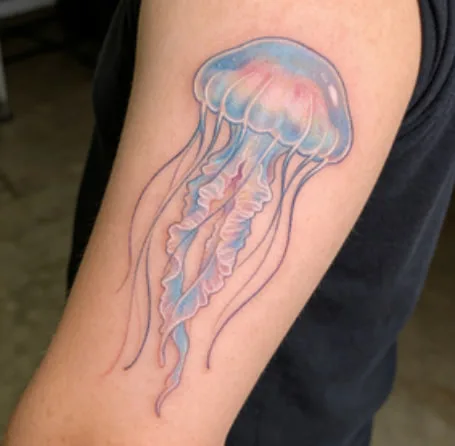
I’ve witnessed an artist at work firsthand. His hand must be steady as a rock. The jellyfish’s tentacles are composed of extremely fine lines. If his hand shakes even slightly, causing a line to break or skew, the entire effect is ruined. What should resemble ribbons floating in water instantly transforms into a tangle of withered branches or stiff sticks.
Once that “flowing sensation” vanishes, the soul is lost. I’ve seen several failed pieces that look like tangled messes plastered onto skin, completely devoid of that ethereal beauty. This taught me that a good tattoo isn’t just about the design—it’s the fusion of technique and understanding. The artist must understand water, understand wind, understand that sense of lightness to convey this beauty.
This is more than just a passing trend.
A few years ago, everyone loved getting infinity symbols (∞) or feathers tattooed. Back then, I thought jellyfish might just be another fleeting fad. People saw others with them and got one too.
But I don’t think that way anymore.
After observing and reflecting for so long, I’ve noticed that people who choose jellyfish tattoos are often quiet yet possess inner strength. They might be survivors in life, weathered by storms yet choosing to treat the world gently. They understand that you don’t always need to tense your muscles for battle—sometimes, going with the flow is true wisdom.
Honestly, I never thought a jellyfish could carry so much meaning for people.
If you’re considering adding this design to your own skin, first ask yourself: Are you truly ready to embrace its story? Because when you walk down the street with it tattooed on you, someone will inevitably ask curiously, “Why did you choose this?”
Then you can tell them it’s not just a beautiful creature, but a way of life. It reminds us that even without hard armor, even when the world is full of unknowns, we can still float gracefully and live strong.
Life is like the ocean—sometimes calm, sometimes stormy. Maybe we don’t always have to be the unbreakable rock getting smashed by the waves. Being more like a jellyfish — just floating along, ending up wherever the current takes you — might actually feel a lot better in the long run.