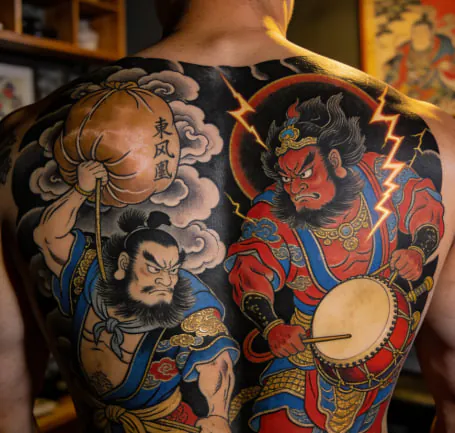
The decision to ink Raijin and Fujin onto my skin was never a spur-of-the-moment choice. These deities, rooted in Japanese folklore and Shinto belief, embody nature’s most primal yet subtle dual forces—destruction and flow, chaos and order, thunderous might and the whisper of a breeze. Before the needle touched skin, it was worth asking: Do their stories mirror your own life’s journey?
From Infatuation to Contemplation: A Decision Brewed Over Three or Four Years.
This wasn’t a decision I made one morning on a whim. The idea had been brewing in my mind for three or four years. What truly moved me was the reverence for natural forces found in Japanese mythology—where thunder tears the sky apart, yet wind silently reshapes the earth. These forces appear opposites, yet they coexist, weaving together the rhythm that governs the world.
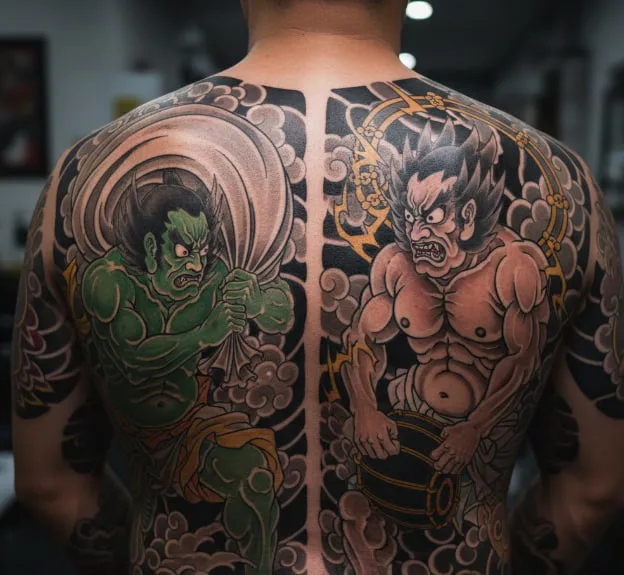
Initially, I immersed myself in ukiyo-e prints, traditional shrine paintings, and classic Japanese tattoo manuals. I rejected cartoonish interpretations, seeking instead a style rich with historical weight and gravitas. My phone gallery filled with depictions of thunder drums and wind sacks by various artists. I pored over comparisons: How could the drum’s arrangement capture the thunder’s fury? How could the folds of the wind sack convey its fluidity? Ultimately, I concluded—such deities demand ample space. The back became the only viable choice. They shouldn’t be confined to arms or calves; only the expansive spine could bear that primal, solemn energy.
Raijin: Creator in the Storm.
- Symbolism: Not merely destruction, but the force that spurs new life. Thunderstorms bring rain that nourishes all things; behind his roar lies the cycle of life.
- Visual Traits: Eyes wide with fury, muscles bulging, hands clenched around thunder drums, body wrapped in lightning. Some versions depict him wielding a hammer, but the drum remains central.
- Do you resonate with hi
If you’ve weathered dramatic upheavals through inner strength; if you believe chaos often heralds renewal; if a restless yet creative energy dwells within you—then the Thunder God may have been waiting for you all along.
Wind God (Fujin): The Invisible, Yet Omnipresent Guide.
- Symbolism: Change, flow, purification. Wind is invisible, yet it drives clouds and dispels mist, sweeping away evil spirits. It strives not for dominance, yet nothing can withstand its force.
- Visual Traits: Often depicted as a burly man bearing a massive windbag on his shoulder, sometimes with greenish skin and a gaze that is sharp yet not savage. The sack billows, as if poised to unleash the breath of heaven and earth at any moment.
- Do you walk alongside him?
If you navigate by the flow, finding direction amid uncertainty; if you believe gentle persistence outlasts fierce resistance; if your creed is “go with the flow, not against it”—then Fujin is your companion.
For me, this pair holds meaning far beyond decoration. It is my acknowledgment of life’s essence: moments of thunderous shattering coexist with healing whispers of gentle breeze. Power never takes just one form.
Dual Symbiosis: Finding Harmony in Opposition.
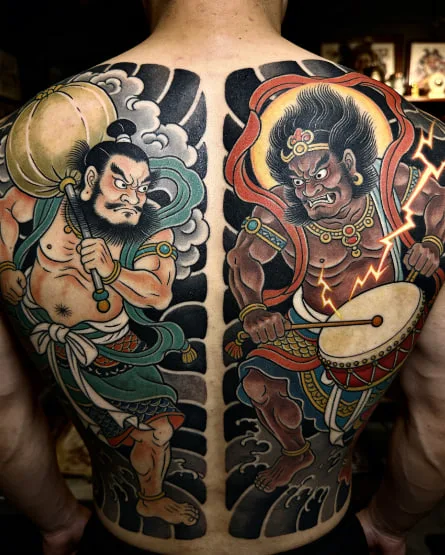
Thunder and Wind Gods placed side by side embody the interdependence of yin and yang. They are not simplistic “good versus evil,” but indispensable polarities within nature’s system. In Japanese tradition, they are often enshrined together at temple entrances—both as warnings and as guardians.
- What does this pairing convey?
- Order within chaos.
- Regeneration behind destruction.
- Acceptance of life’s contradictions.
- A dual shield against external calamity and internal turmoil.
- Is it right for you?
If you often find yourself torn between reason and emotion, career and family, extroversion and introspection;
if you yearn for breakthroughs yet crave stability;
Respect is the prerequisite for inking deities.
The Thunder God and Wind God are not mere pop icons, but deeply ingrained objects of faith within Japanese culture. Choosing them signifies your willingness to understand their spiritual weight, not merely their visual impact.
Ensure your motivation extends beyond “it looks cool”—truly embrace the truth that each of us lives within the interplay of these natural forces. Tattooing them is a tribute to this cosmic rhythm and an open acceptance of life’s complexity.
Comment on “Raijin and Fujin Tattoo Meaning: Thunder, Wind, and the Dual Forces of Life”